German
  English
  Japanese
  Chinese
  Spanish
  Portuguese
Enabling Scalable Co-Packaged Optics: The Critical Role of Optical Connectivity and Fiber Management
 Introduction: From Architecture to Implementation
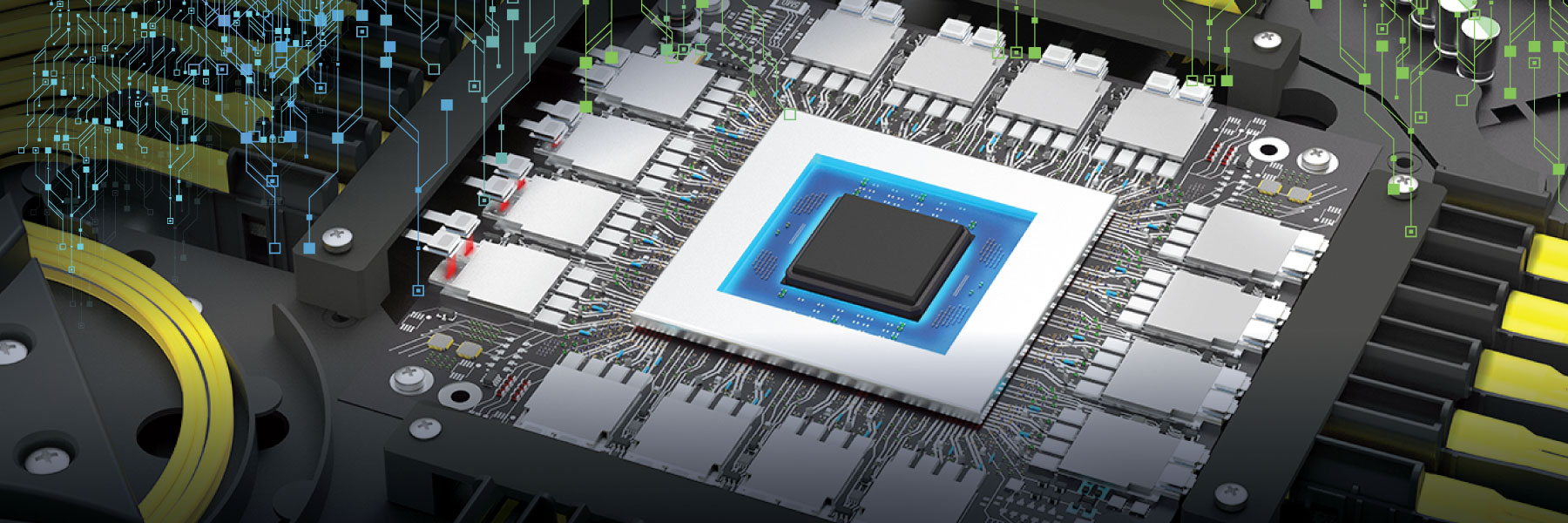
Co-Packaged Optics (CPO) promises a step-change in power efficiency, bandwidth density, and system performance. However, as discussed in previous articles, real-world deployment introduces significant challenges—particularly in yield, reliability, and serviceability.
While much of the industry focus remains on silicon photonics and ASIC integration, the success or failure of CPO at scale depends on a less visible but equally critical layer: optical connectivity and fibre management.
As systems evolve from front-panel modularity to integrated architectures, connectivity is no longer a passive component. It becomes a strategic enabler of scalability, manufacturability, and long-term operability.
The Hidden Complexity of CPO Systems
CPO fundamentally changes how optical interconnects are deployed within data center systems.
In traditional pluggable architectures:
- Fiber connections are external
- Cabling is standardized and accessible
- Maintenance is straightforward
In contrast, CPO introduces:
- Internal fiber routing within the system
- Dense, tightly constrained optical environments
- Permanent or semi-permanent optical interfaces
This creates a new level of complexity that must be engineered from the ground up.
Fiber Density: Scaling Beyond Traditional Limits
AI-driven data centers require dramatically higher interconnect density.
With CPO:
- Port counts increase significantly within a single switch
- Optical engines are distributed across the package
- Fibre connections shift from external to internal routing
This leads to a rapid increase in fibre count per system.
Key Challenges
- Physical congestion: Managing hundreds or thousands of fibers within limited space
- Airflow disruption: Poor cable management can impact cooling efficiency
- Installation complexity: Increased risk of errors during assembly
Requirement
CPO systems demand a new approach to:
- High-density fibre routing
- Structured cable management
- Scalable internal connectivity design
Precision Alignment: The Sub-Micron Challenge
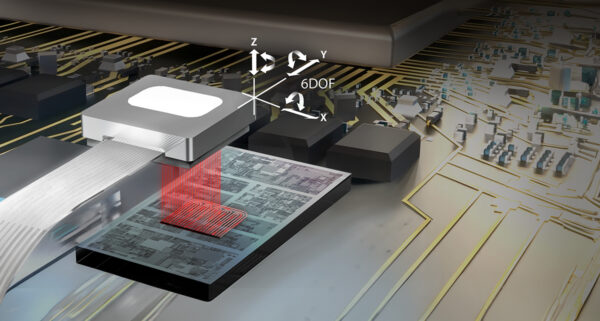
Unlike pluggable optics, which operate with relatively forgiving mechanical tolerances, CPO systems rely on extremely precise optical alignment.
Why This Matters
- Single-mode fibre cores are typically ~9 microns in diameter
- Efficient optical coupling requires sub-micron precision
- Misalignment results in signal loss and degraded performance
Herausforderungen
- Maintaining alignment during assembly
- Ensuring stability under thermal expansion
- Preserving accuracy over time and operational cycles
Requirement
Connectivity solutions must deliver:
- High-precision mechanical design
- Stable, repeatable alignment
- Minimal insertion loss at scale
This shifts connectors from simple interfaces to precision-engineered systems.
Yield Optimization: Decoupling Risk in Manufacturing
As highlighted in earlier discussions, manufacturing yield is one of the biggest barriers to CPO adoption.
The challenge lies in integrating multiple high-value components into a single package without introducing failure points.
The Core Issue
- Optical engines, ASICs, and interconnects must all function perfectly together
- A failure in any element can compromise the entire system
Connectivity as a Solution Layer
Advanced connectivity approaches can help mitigate this risk by:
- Enabling detachable optical interfaces
- Supporting validation of sub-components before final integration
- Reducing dependency on full-system assembly for testing
Impact
- Improved manufacturing yield
- Lower production risk
- Greater flexibility in system assembly
This represents a shift toward modular thinking within integrated architectures.
Serviceability: Reintroducing Modularity
One of the most significant operational challenges in CPO is the loss of hot-swappable optics. Connectivity innovation plays a key role in addressing this limitation.
Traditional Limitation
- Embedded optical engines are difficult to access
- Faults may require full system replacement
Emerging Approaches
New connectivity designs enable:
- Partial disaggregation of optical components
- Replaceable or serviceable interconnect elements
- More targeted maintenance interventions
Impact
- Reduced downtime
- Improved lifecycle management
- Lower total cost of ownership
The goal is not to fully replicate pluggable flexibility, but to introduce practical serviceability within integrated systems.
Thermal and Mechanical Stability
CPO systems operate in high-density, high-temperature environments. Connectivity solutions must therefore perform reliably under:
- Elevated temperatures
- Continuous high-bandwidth operation
- Mechanical stress from system integration
Key Requirements
- Materials that maintain structural integrity at high temperatures
- Designs that resist deformation and misalignment
- Long-term reliability under sustained load
This adds another layer of complexity to connector and fibre management design.
The Shift from “Outside-the-Box” to “Inside-the-Box” Optics
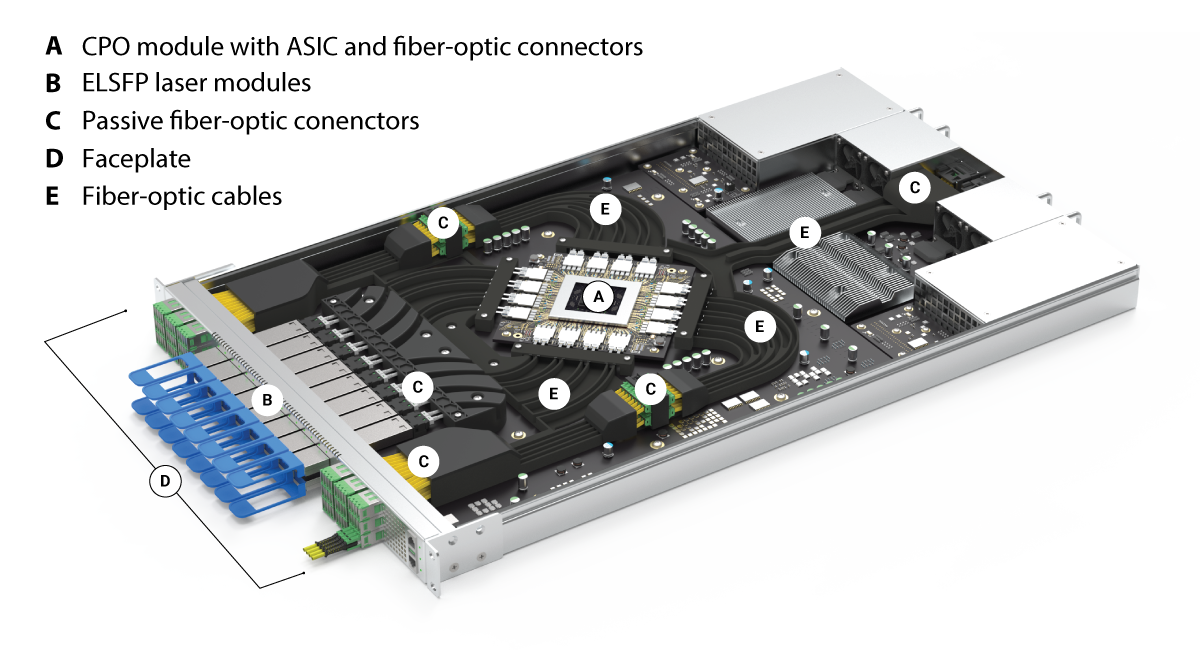
In traditional architectures, optical connectivity is largely external. Co-Packaged Optics (CPO) changes that. Fiber routing becomes an integral part of the system architecture, where mechanical, thermal, and optical design must be considered together from the start. Connectivity is no longer a peripheral component—it is a core design constraint. Success depends on close collaboration between ASIC designers, system architects, and optical connectivity specialists to optimize performance, manufacturability, and serviceability.
The Strategic Role of Optical Connectivity
As CPO adoption accelerates, optical connectivity emerges as a critical enabler of:
Skalierbarkeit
- Supporting higher fibre counts
- Enabling dense, efficient system designs
Manufacturability
- Improving yield
- Reducing assembly complexity
Reliability
- Ensuring consistent optical performance
- Maintaining alignment under real-world conditions
Serviceability
- Introducing modularity into integrated systems
- Enabling practical maintenance strategies
Together, these capabilities determine whether CPO can move from limited deployment to widespread adoption.
Conclusion: From Component to Critical Infrastructure
The transition to Co-Packaged Optics is not solely a story of silicon innovation. It is equally a story of how systems are physically connected, managed, and maintained.
As optical engines move inside the package, connectivity moves from the edge of the system to its core.
Enabling this transition requires:
- Precision engineering
- Scalable fibre management
- Innovative approaches to modularity and serviceability
For data centre operators and system designers, the success of CPO will depend not only on what happens on the chip, but on how effectively the entire optical ecosystem is integrated and managed.
Optical connectivity is no longer just an interface—it is a foundational technology enabling the future of high-performance, energy-efficient data infrastructure.

Datenzentrum