Spanish
  English
  Japanese
  Chinese
  Portuguese
  German
CPO frente a módulos enchufables: comparativa de rendimiento, potencia y escalabilidad en la era de 800G–3,2T
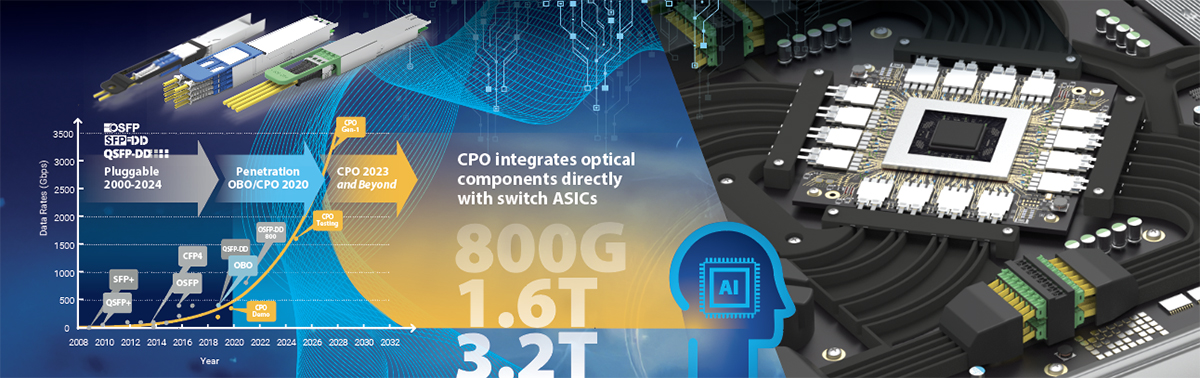
Introduction: From Evolution to Evaluation
As data centre networks transition into the era of 800G, 1.6T, and future multi-terabit architectures, the conversation is shifting from “what comes next?” a “what performs best?”
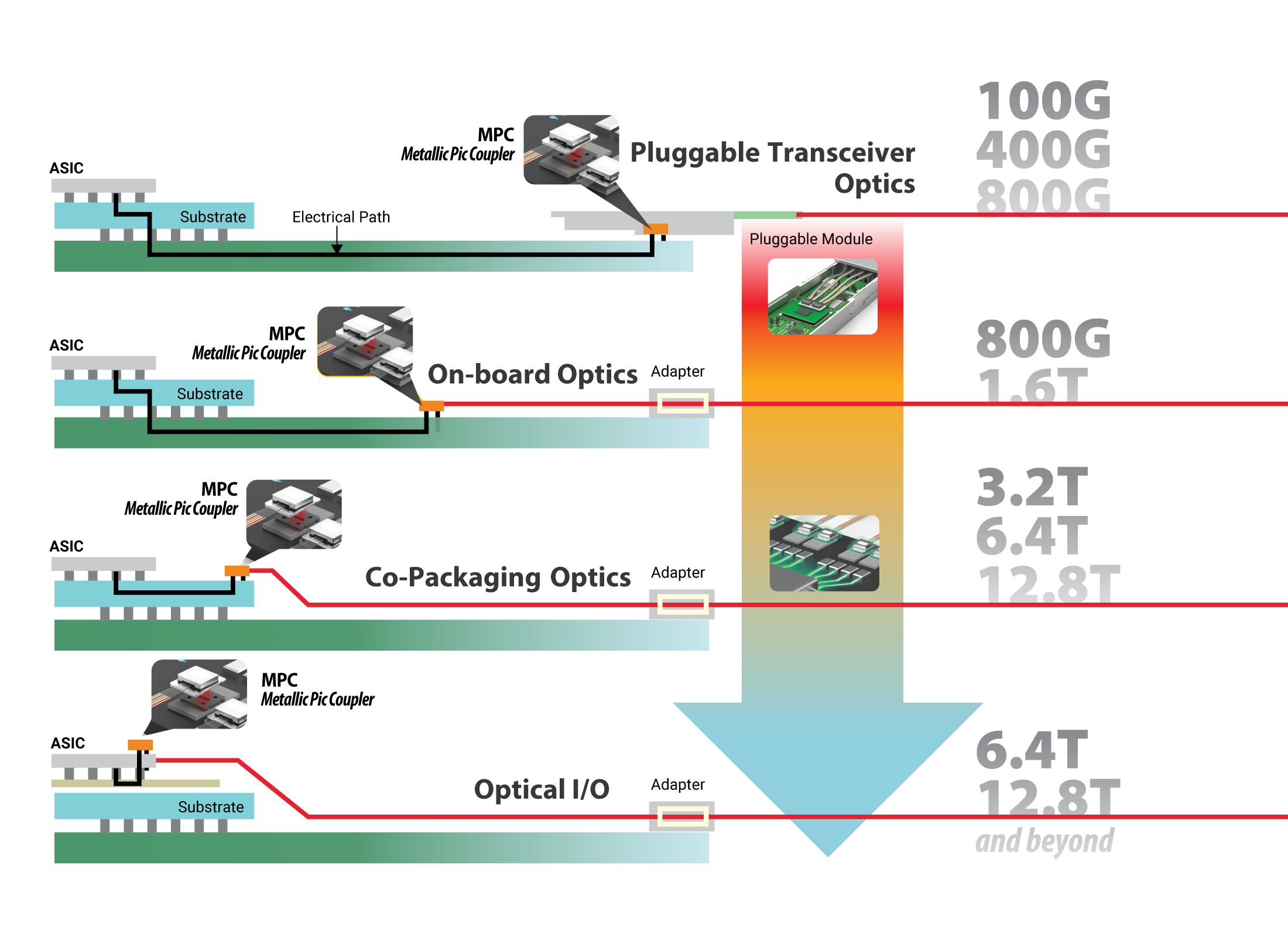
While Co-Packaged Optics (CPO) represents a clear architectural progression, pluggable optics and Near-Packaged Optics (NPO) continue to play important roles in deployed infrastructure today. Each approach carries distinct advantages and limitations across power consumption, performance, scalability, and operational flexibility.
Understanding these trade-offs is critical for hyperscalers and AI infrastructure providers as they define their networking strategies for the next generation of systems.
Architectural Comparison at a Glance
At a fundamental level, the differences between pluggable optics, NPO, and CPO are driven by the distance between the switch ASIC and the optical interface.
| Architecture | Optical Placement | Electrical Path Length | Integration Level |
| Pluggable Optics | Front panel module | Long (10–30 cm) | Low |
| NPO | Adjacent to ASIC on PCB | Short (a few cm) | Medium |
| CPO | Co-packaged with ASIC | Ultra-short (mm) | High |
This variation in electrical path length is the primary driver behind differences in power consumption, signal performance, and overall system efficiency.
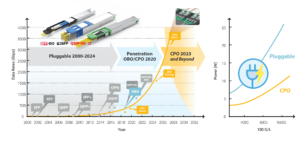
Power Consumption: The Primary Battleground
Pluggable Optics
Pluggable optics require high-performance signal conditioning to transmit data across long electrical traces. This drives:
- High SerDes power consumption
- Increased DSP complexity
- Higher per-port energy usage
At higher speeds, these factors result in rapidly increasing power demands, making pluggables less sustainable as data rates scale.
Near-Packaged Optics (NPO)
NPO reduces electrical trace length and therefore lowers the burden on signal conditioning components. This leads to:
- Moderate reductions in power
- Mejora de la integridad de la señal
- Better efficiency than pluggables
However, because optical modules remain discrete, gains are incremental rather than transformational.
Óptica de empaquetado conjunto (CPO)
CPO delivers a structural shift in power efficiency by minimizing electrical transmission distance:
- Reduced reliance on high-power SerDes
- Elimination of long PCB traces
- Lower total energy per transmitted bit
The result is a step-change improvement in power efficiency, particularly at 1.6T and beyond, where traditional approaches become increasingly constrained.
Signal Performance and Latency
As transmission speeds increase, signal integrity becomes a defining constraint.
Pluggables
- Long electrical paths introduce signal attenuation and noise
- Require extensive equalisation and error correction
- Latency is impacted by signal conditioning stages
NPO
- Shorter electrical paths reduce attenuation
- Improved signal quality compared to pluggables
- Better performance at higher speeds
CPO
- Electrical distances are reduced to millimetres
- Minimal signal loss before optical conversion
- Lower latency and improved signal fidelity
This enables reliable operation at very high data rates without the escalating power penalties associated with electrical compensation.
Bandwidth Density and System Scalability
One of the most significant advantages of CPO lies in how it redefines system scalability.
Pluggables: Faceplate-Constrained Scaling
- Port density limited by physical front-panel space
- Increasing bandwidth requires larger or more numerous systems
- Airflow and cooling constraints intensify with density
NPO: Incremental Improvement
- Higher density than pluggables
- Still constrained by module packaging and board design
CPO: Decoupled from the Faceplate
- Optical engines integrated within the switch package
- Enables significantly higher port counts within the same footprint
- Supports ultra-high-radix switch designs
This shift allows data centres to scale bandwidth without proportionally increasing physical infrastructure.
Thermal Efficiency and Cooling Implications
Power and thermal performance are closely linked in high-density AI systems.
Pluggables
- High power density at the front panel
- Cooling becomes increasingly difficult
- May require complex airflow or liquid cooling solutions
NPO
- Distributes heat more evenly across the board
- Reduces localized thermal hotspots
CPO
- Enables more controlled thermal design around the ASIC package
- Reduces overall heat generated by optical interconnects
- Supports more efficient system-level cooling strategies
Lower thermal load directly contributes to improved reliability and reduced operating costs.
Operational Considerations: Flexibility vs Integration
Beyond raw performance, deployment models must account for operational realities.
Pluggables
- Fully modular and hot-swappable
- Easy to upgrade, replace, and scale incrementally
- Well-established supply chains and standards
NPO
- Semi-integrated but still serviceable
- More complex than pluggables but retains some modularity
CPO
- Highly integrated and tightly coupled to the system
- Limited serviceability compared to pluggables
- Requires new approaches to reliability and lifecycle management
This highlights a key trade-off: maximum efficiency comes at the cost of flexibility.
Where Each Architecture Fits
Rather than a single winner, the industry is likely to adopt a hybrid approach depending on application requirements.
- Pluggables will remain relevant for:
- Enterprise networks
- Lower-speed applications
- Environments requiring flexibility
- NPO will serve as:
- A transition technology
- A balance between performance and serviceability
- CPO will dominate in:
- Hyperscale data centres
- AI training clusters
- Ultra-high-bandwidth environments
This layered adoption model reflects both technical and operational realities.
Strategic Implications for Next-Generation Networks
As AI workloads continue to scale, network design priorities are shifting toward:
- Energy efficiency at scale
- Bandwidth density and performance
- System-level optimisation
CPO addresses these priorities more directly than previous architectures, positioning it as a key enabler of next-generation infrastructure.
However, its adoption will depend on the industry’s ability to address integration complexity, reliability, and serviceability challenges.
Conclusion: A Multi-Architecture Future
The transition from pluggables to co-packaged optics is not a simple replacement cycle—it is a redefinition of how data centre networks are designed and scaled.
Pluggable optics provide flexibility and maturity.
NPO offers incremental improvement.
CPO delivers the efficiency and scalability required for the future.
The question is no longer if CPO will be adopted, but where and how quickly it will complement—or replace—existing architectures.
For organisations designing next-generation AI infrastructure, understanding these trade-offs is essential to making informed, future-proof decisions.
Centro de datos