Spanish
  English
  Japanese
  Chinese
  Portuguese
  German
Cómo seleccionar el transceptor adecuado para su red
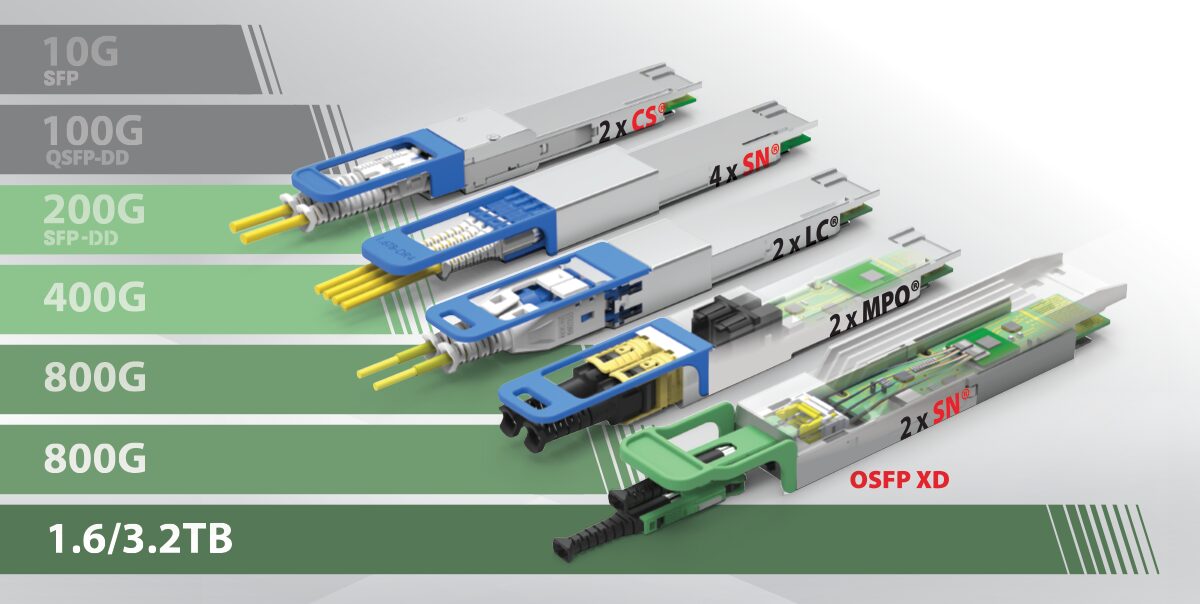 Choosing the right transceiver is a vital step in building a robust and scalable network. The selection process involves evaluating several key factors to ensure compatibility, performance, and future-proofing. There are mainly 8 factors to consider.

1. Form Factor
Transceiver form factors determine their physical size and compatibility with network equipment. Different form factors have been introduced throughout the years, with the most commonly deployed transceivers today being the SFP, SFP-DD, QSFP, QSFP-DD, and OSFP. The different form factors also describe the electrical interfaces to the host equipment. For example, an SFP has a single electrical I/O interface, while a Quad SFP (QSFP) has four. As the demand for bandwidth grows, transceivers with higher densities are in demand. This trend is seen with the increased adoption of QSFP-DD and OSFP transceivers due to their higher number of electrical interfaces and compact design.

2. Data Rate
Transceivers with the same form factor can have different data rates. The number following the form factor denotes the data rate in Gigabits per second (Gbps). For example, a QSFP28 denotes 4 lanes of 25Gbps for a total of 100Gbps, while a QSFP56 denotes 4 lanes of 50Gbps for a total of 200Gbps.
3. Transmission Type
The transmission type describes the signal type that will be used for the network. Some of the common transmission types are Coarse Wavelength Division Multiplexing (CWDM), Dense Wavelength Division Multiplexing (DWDM), PAM4, NRZ, and Bi-directional.
4. Protocol
A protocol serves as the communication language for network devices, enabling the transmission and reception of messages between them. Each protocol has a unique method of encapsulating and interpreting signals, but ultimately, it breaks down to binary data – sequences of 0s and 1s.
The most used protocol in data centers are Ethernet, Fiber Channel, and OTU. While in data centers for AI and Machine Learning, the InfiniBand protocol is the most common. CPRI and eCPRI is widely deployed for wireless networks.
5. Media Type
The media type identifies whether the network uses fiber optic cables or copper cables. The use of fiber optics can further be divided into multimode fiber for shorter transmission distance which is typically deployed for transmission within data centers or in campus networks, or single-mode fiber for longer distance transmission such as inter-data center networks and in Passive Optical Networks (PONs).
6. Reach
As outlined in the previous section, multimode transceivers will have short transmission distances of up to about 550m, while single mode transceivers will support longer distances of up to 80km and beyond. A transceiver module’s range is usually denoted by a letter in its naming abbreviation.
7. Temperature Range
Transceivers may be deployed in various locations and not just in telecommunication exchanges and data centers with controlled temperature and humidity. Standard transceivers can usually operate between 0°C and 70°C, with some hyperscale operators requiring even less stringent temperature range control to reduce costs.
There are extended transceivers that are suitable for deployment in uncontrolled environments such as in outdoor cabinets or in microcells, and industrial transceivers that support a wider range of temperatures from -40°C to 85°C, and is suitable for harsh conditions.

8. Connector Type
Connector types impact ease of installation and scalability. The most common type of connectors used in transceivers used to be SC, LC, and MPO connectors. With the demand for higher density, transceivers using Very Small Form Factor (VSFF) connectors such as the CS, SN, and SN-MT connectors were introduced. These new connectors enable the development of multiple connectors in a single transceiver and increased transmission lanes.
Transceiver Naming Abbreviation
Transceiver modules have abbreviations that provides information about the transceiver characteristics. The numbers at the front indicates the transceiver bitrate. If only numbers are displayed, they indicate a bitrate in Megabits per second. Higher bitrates will include their multiplier such as 400 G which indicates 400 Gigabits per second.
There can be four alphanumeric at the end to indicate additional information. The first number indicates the number of channels. A number is not displayed if there is only one channel. The next alphabet indicates the range and wavelength. The next alphabet indicates its coding method, while the last alphabet indicates the number of lanes. This can be the number of fibers, or wavelengths. A number is not displayed if there is only one lane.
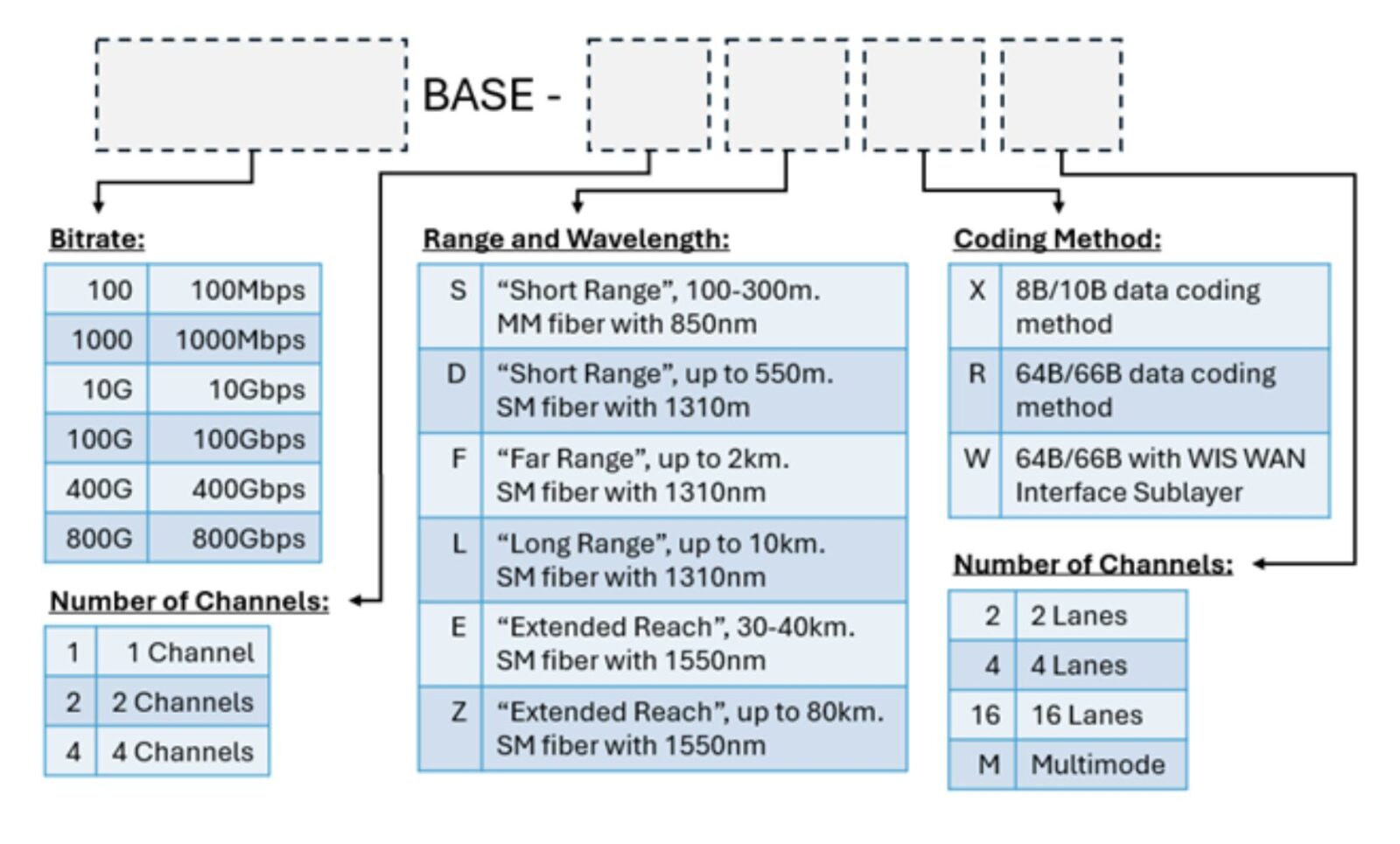
For example, 400G BASE-2FR4 denotes:
- 400Gbps transmission bandwidth
- 2 channels with each channel being 200Gbps
- “Far Reach” transceiver using 1310nm wavelength over SM fiber up to 2km
- Transceiver uses 64B or 66B data coding method
- 4 lanes per 200Gbps channel, equaling to 50Gbps per lane

SENKO’s Contribution to Transceiver Development
SENKO Advanced Components has been instrumental in advancing transceiver technology, particularly through their development of the SN® and SN-MT connectors. These connectors are designed for high-density applications and next-generation transceivers, including SFP-DD, QSFP-DD, and OSFP. The compact design of SENKO’s Very Small Form Factor (VSFF) duplex SN fiber connectors allow significant space-saving in data center and telecom applications.
Furthermore, SENKO has collaborated with industry partners to develop 1.6TB/s pluggable optical modules using SN and SN-MT optical connectivity. These connectors facilitate ‘direct-break out’ for flexible infrastructure design, enhancing deployment into hyperscale data centers.
By considering these factors and leveraging innovations from industry leaders like SENKO, you can select transceivers that meet your current network needs while positioning your infrastructure for future advancements.

Centro de datos