Portuguese
  English
  Japanese
  Chinese
  Spanish
  German
Energy Efficiency in Co-Packaged Optics: Redefining the Power Envelope of AI Infrastructure
Introduction: The Power Challenge Behind AI Growth
The rapid expansion of artificial intelligence and hyperscale cloud infrastructure is driving unprecedented demand for bandwidth. As networks transition from 800G to 1.6T and beyond, the industry is facing a fundamental constraint: power consumption.
In modern data centers, the energy required to move data is becoming as significant as the energy required to process it. Optical interconnects—long considered a supporting component—are now central to determining overall system efficiency, scalability, and cost.
Traditional architectures based on front-panel pluggable optics are increasingly unable to meet these demands, prompting a shift toward more integrated approaches such as Near-Packaged Optics (NPO) and Co-Packaged Optics (CPO).
From Pluggables to Co-Packaged Optics: Front-Panel Pluggable Optics (FPP)
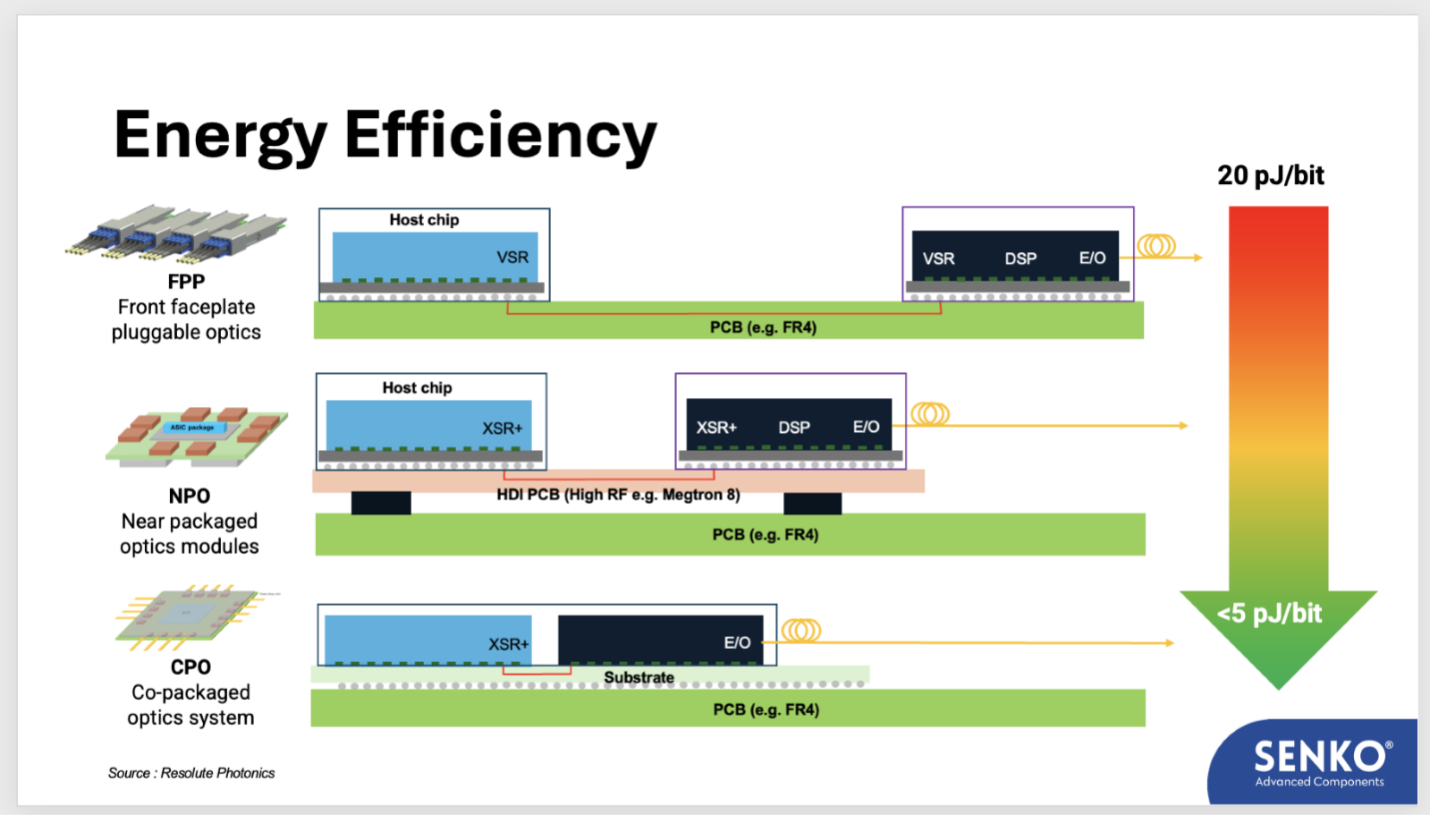
Pluggable optics have been the foundation of data centre connectivity for over a decade. In this architecture, optical transceivers sit on the front panel and connect to the switch ASIC via electrical traces on the PCB.
As data rates increase, these electrical paths become a major source of inefficiency:
- Longer trace lengths introduce signal loss
- High-performance SerDes and DSP components are required
- Power consumption increases significantly at higher speeds
At 800G and beyond, these constraints make further scaling increasingly inefficient.
Near-Packaged Optics (NPO)
NPO brings optical engines closer to the switch ASIC, reducing electrical trace length and improving signal integrity.
This approach delivers:
- Moderate reductions in power consumption
- Improved electrical performance
- Higher interconnect density
However, NPO still relies on discrete optical modules, limiting the full efficiency gains achievable through deeper integration.
Óptica de pacote conjunto (CPO)
CPO represents a fundamental architectural shift. By integrating optical engines within, or directly adjacent to, the switch ASIC package, CPO minimizes the electrical path between compute and optical domains.
This results in:
- Dramatically reduced signal loss
- Lower dependence on power-intensive SerDes
- Improved thermal and electrical efficiency
CPO enables a transition from centimetre-scale electrical paths to millimetre-scale integration, fundamentally changing the energy dynamics of high-speed networking.
Quantifying Energy Efficiency Gains
The differences in energy efficiency between these architectures become significant at higher data rates.
- Pluggable optics: Typically operate at higher energy per bit due to long electrical paths and signal conditioning requirements
- NPO: Offers incremental improvements by shortening electrical reach
- CPO: Achieves a step-change reduction in energy per bit through integration
In practical terms, CPO architectures can deliver:
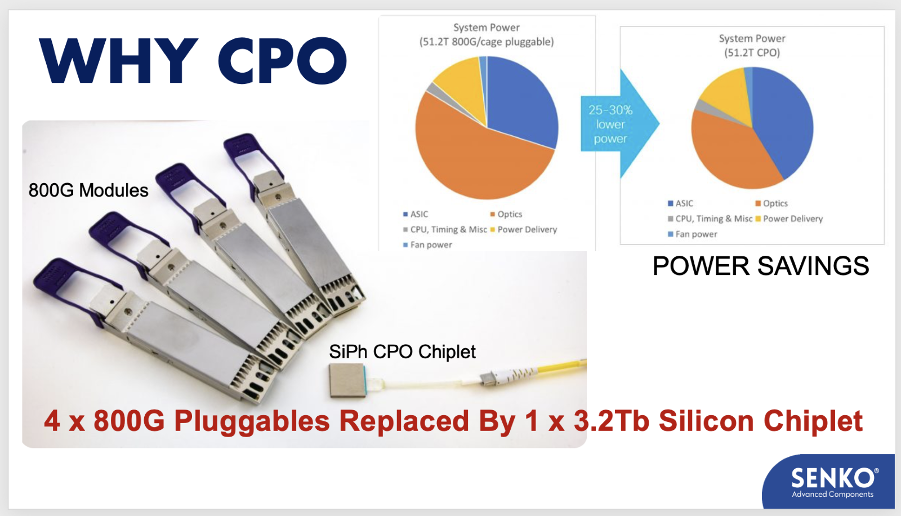
- Up to 4× improvement in energy efficiency per bit
- Significant reduction in per-port power consumption
- Lower overall system power requirements
As switching platforms scale to 51.2Tbps and beyond, these gains become critical to maintaining manageable power budgets.
System-Level Impact: Beyond the Optical Module
Energy efficiency is not limited to the optics themselves—it has a cascading effect across the entire system.
Key areas of impact include:
1. Total System PowerOptical interconnects represent a substantial portion of total switch power. Reducing optical power consumption directly lowers overall system energy demand.
2. Cooling RequirementsLower power dissipation reduces thermal load, enabling:
- More efficient cooling strategies
- Higher rack densities
- Reduced infrastructure costs
3. Bandwidth Density
With less power allocated to interconnects, systems can support:
- Higher port counts
- Greater throughput per rack
- More efficient scaling of AI workloads
Implications for AI and Hyperscale Data Centres
As AI workloads continue to scale, data movement between compute nodes is becoming a dominant factor in both performance and cost.Improved optical efficiency enables:
- Higher-performance AI clusters
- More efficient model training and inference
- Reduced operational expenditure driven by power and cooling
In this context, energy-efficient interconnects are no longer optional—they are foundational to the scalability of next-generation infrastructure.
The Role of Optical Connectivity
While much of the focus on CPO centres on silicon photonics and ASIC integration, the success of these architectures depends equally on advances in optical connectivity.
As systems evolve toward higher density and tighter integration, connectivity solutions must enable:
- Reliable high-density fibre routing
- Low-loss optical interfaces
- Scalable and manufacturable designs
This creates new opportunities for innovation in connector design, fibre management, and system integration—critical enablers of practical CPO deployment.
Conclusion: A Structural Shift in Network EfficiencyThe transition from pluggable optics to co-packaged architectures marks a turning point in data centre design. As data rates climb and AI workloads intensify, energy efficiency has become a primary constraint on growth.
CPO addresses this challenge by fundamentally rethinking the relationship between compute and connectivity—delivering a step-change improvement in power efficiency, bandwidth density, and scalability.
For hyperscalers and AI infrastructure providers, this evolution is not simply about performance—it is about enabling the next generation of digital infrastructure within realistic power and cost boundaries.

Centro de dados