English
 Japanese
 Chinese
 Spanish
 Portuguese
 German

OCP 2026 Optical Backplanes Reshape the Architecture of AI Infrastructure
SENKO Advanced Components | 21 October 2026
From parallel optical channels to detachable fiber interfaces, six trends reveal how the physical connection is shaping the next generation of AI racks.
OCP 2026 brought a more demanding question into focus for optical interconnection: how does bandwidth become usable computing capacity when the network must fit inside a densely populated, liquid-cooled rack? The answer depends on the complete physical path, from the optical engine and its fiber attachment to the backplane that connects replaceable compute and switch trays.
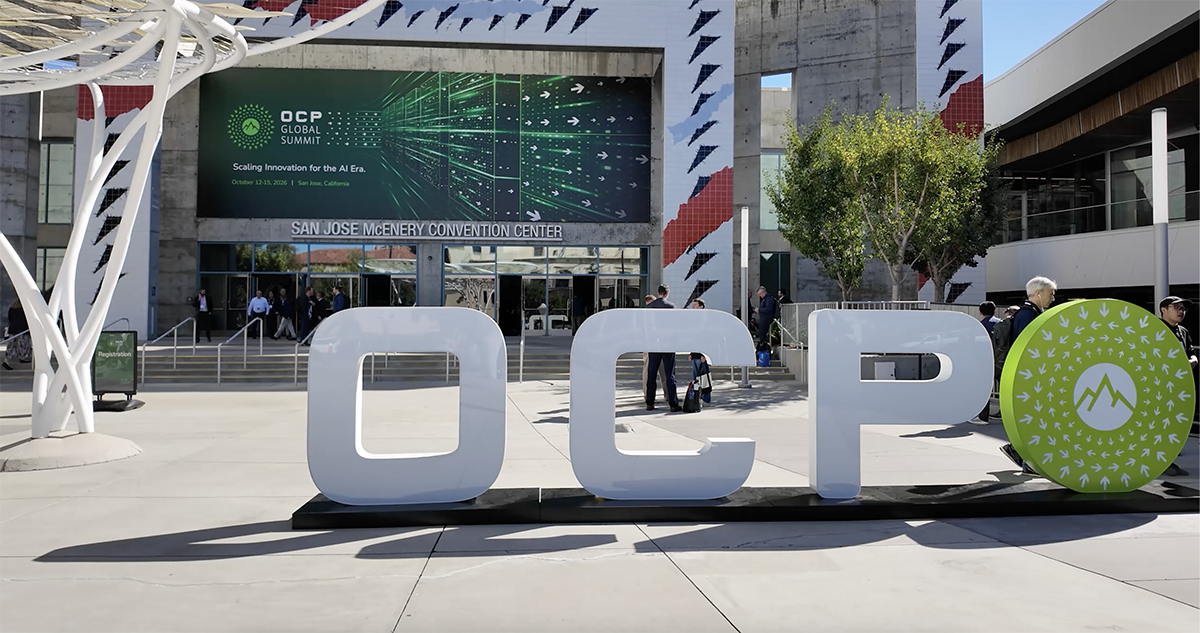
Across the Open Compute Project Global Summit in San Jose, held from 12 to 15 October, optical backplanes, co-packaged optics and live optical I/O systems made that path increasingly tangible. The significance lay in the integration: photonics was being designed into the mechanical envelope, assembly sequence and operating model of AI infrastructure.
For SENKO, this is where decades of optical connectivity engineering acquire new importance. A connector determines how densely fibers can be arranged, where a system can be disconnected, and how consistently an optical path can be re-established. Those decisions influence the architecture well before a technician installs the finished hardware.
Six trends from OCP illustrate how that relationship is evolving.
Trend 1: Optical backplanes bring bandwidth and reliability into rack design
Scale-up networks allow GPUs and accelerators to exchange data as part of a tightly coupled computing system. As those systems grow, electrical reach and the physical bulk of interconnects influence how far apart processors can be placed. Moving conversion closer to the silicon through near-package optics (NPO) or co-packaged optics (CPO) shortens the high-speed electrical path. It also creates a substantial fiber-routing task inside the chassis.
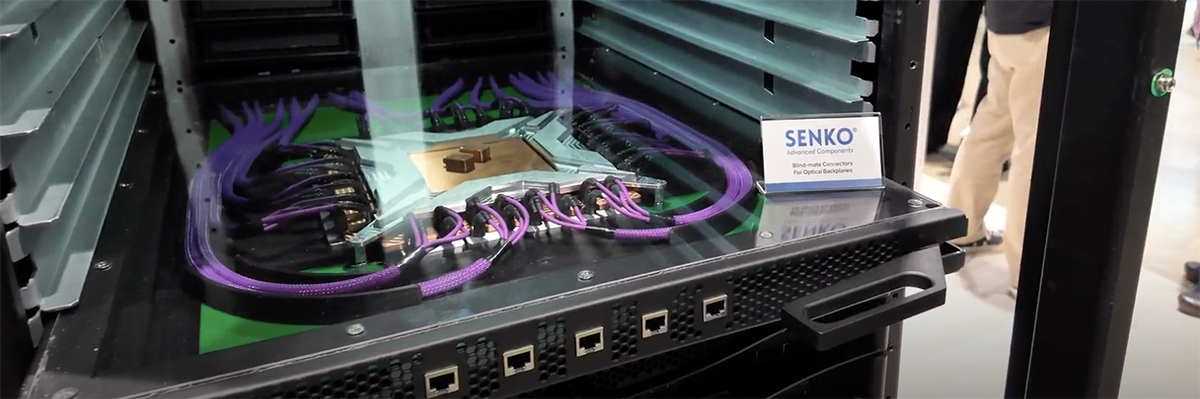
The optical backplane becomes a means of organizing those paths across modular hardware. In a blind-mate arrangement, the optical interfaces engage as a tray is inserted. This brings optical alignment into the rack’s mechanical design where connector alignment, optical performance, fiber density, and accessibility for maintenance is a crucial requirement. The backplane optical assembly is expected to go through repeated installation and removal throughout its operational lifetime and must maintain high optical performance.
Credo’s ZeroFlap Blindmate Optical Backplane, developed with SENKO, made this relationship particularly visible. Its micro-emitter approach distributes traffic across many parallel optical channels operating at lower individual rates. Credo’s post-show technical account describes a backplane architecture carrying 30 Pb/s across one million fibers, with 15% over-provisioning for hitless fiber failover as reported through Credo’s stated architectural figures.
Redundancy is as significant as the bandwidth. Spare channels provide a way to accommodate a failed path without resetting the overall connection. For a tightly coordinated accelerator workload, avoiding an interruption can matter alongside increasing peak throughput. The design therefore places channel count, physical density and fault tolerance within the same engineering problem.
SENKO’s contribution is at that physical interface, where a highly parallel optical architecture must become a repeatable connection. As fiber counts increase, the connector must preserve alignment across the array while supporting the modularity the rack requires. Credo’s approach illustrates why backplane connectivity is becoming an early architectural decision. The mechanics of the optical backplane connectivity must be developed in tandem to support the optical channel design.
Trend 2: Copper and optics are being engineered around the same rack constraints
OCP also showed why the transition will involve several interconnect approaches. Copper remains relevant where distance, cost and electrical performance fit the application. Optical links provide another design option as reach and routing requirements expand. The decision is increasingly about the complete channel and its place in the system, including the power and cooling needed to sustain it.
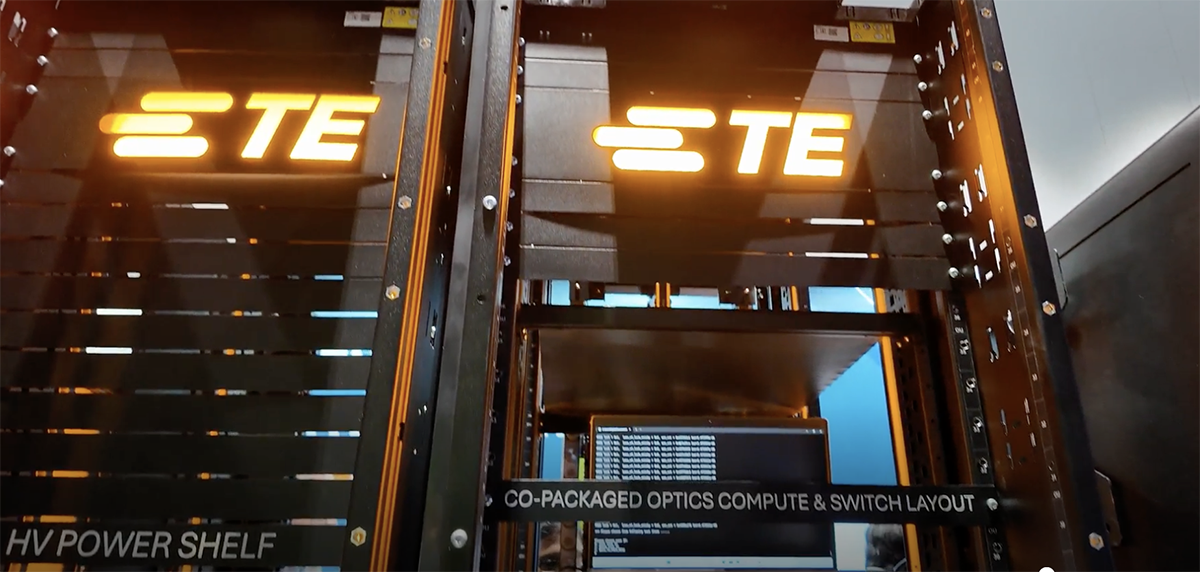
TE Connectivity’s programme captured this coexistence. Its copper rack featured STRADA Whisper Ultra 336G backplane and mid-plane solutions, while a separate demonstration connected co-packaged copper to a cabled backplane over a one-meter 448G channel. Its optical rack combined NPO, optical modules, high-density fiber routing, backplane connectivity and liquid cooling.
These examples reveal a shared design pressure. Moving an electrical or optical interface closer to the processor can relieve one constraint while creating another. The physical constraints of cable exit space, socket access, fiber bend radius, and clearance around a cold plate become an integral part of rack design. A compact connector is useful only if the surrounding harness can be routed and serviced without compromising the rest of the tray.
SENKO’s high-density and blind-mate connectivity addresses this physical design challenge. The useful measure extends beyond fiber density per connector to the space required for mating, routing and maintenance. A backplane interface that allows a tray to be operated without disturbing neighboring fiber paths can support modular service procedures. Achieving that requires the optical connection to be designed with the chassis.
TE’s showcase is therefore important to the wider backplane story. Copper and optical systems are advancing within the same limited rack envelope. Their development makes connectivity, power delivery, and cooling interdependent design choices, reinforcing the value of bringing optical interface expertise into the process from the outset.
Trend 3: Co packaged optics is taking shape as complete rack hardware
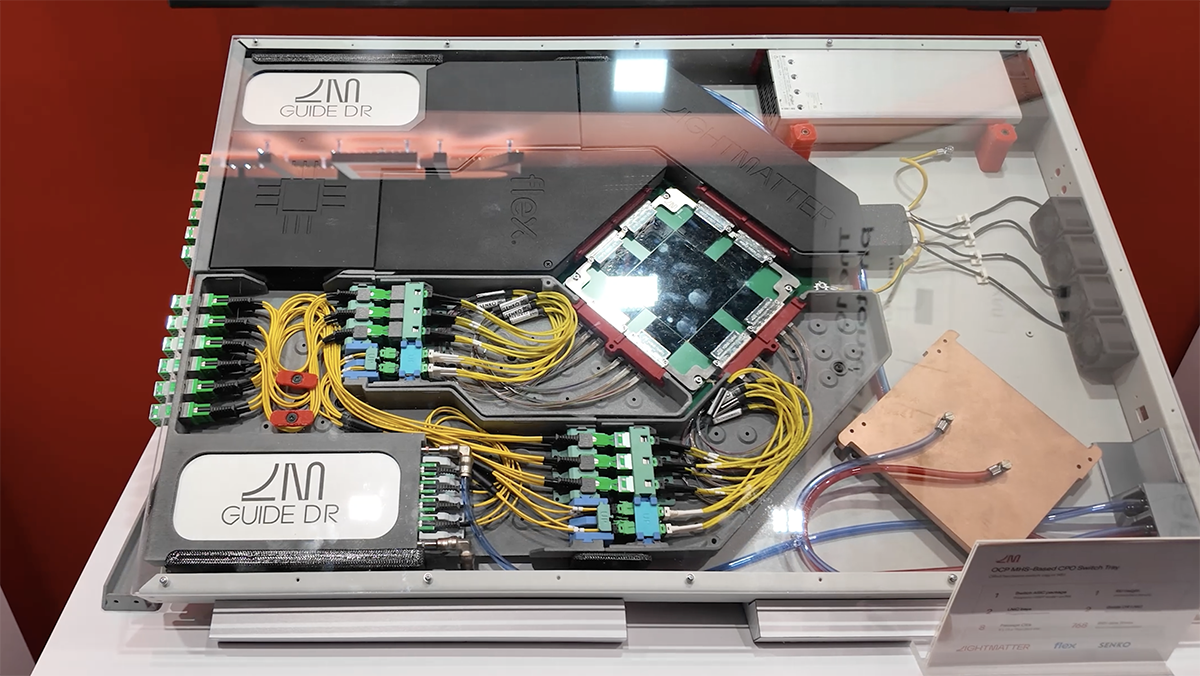
Lightmatter’s OCP systems provided two distinct examples of this integration. With Flex, it developed a 204.8 Tbps CPO switch tray within 1RU space as a production-validation platform. A separate 102.4 Tbps XPU prototype used infrastructure from another original design manufacturer and accommodated four accelerators and two CPUs in a 2U compute tray. Both used SENKO fiber connectivity and were built around Open Rack Version 3 (ORv3) and Modular Hardware System (MHS) specifications.
The switch integrated eight bidirectional Passage engines with Guide DR external laser modules in a liquid-cooled chassis. The compute design used four Passage engines and blind-mate optical connectivity as the tray entered the rack. SENKO supplied high-density fiber arrays and connectors across the systems.
Bidirectional transmission is relevant to the physical architecture because carrying traffic in both directions over a fiber can reduce the fiber count required for a given connection. That changes the routing problem inside the tray, where optical harnesses share space with compute packages and cooling hardware. Bandwidth density consequently depends on both the optical transmission scheme and the way its fibers are connected and managed.
These platforms also give the manufacturing discussion a concrete setting. A switch designed with a manufacturing partner can be evaluated for assembly sequence and production repeatability. A compute prototype can expose mechanical and thermal integration issues that a stand-alone optical engine does not reveal. Each advances a different part of the route towards deployable hardware.
For SENKO, involvement in both designs places connectivity engineering inside that development process. Fiber attachment, compact interconnection and service access can be considered alongside the optical engine and chassis. The result is a more meaningful role of the connector in preserving the benefits of photonic integration as the design moves from a package into a complete system.
Trend 4: Detachable interfaces change the manufacturing sequence
Fiber attachment is one of the most consequential steps in CPO manufacturing. Integrating expensive compute silicon and optical engines makes the timing of testing important. Finding defects before final package assembly eliminates the risk of committing further manufacturing effort and resources to a faulty component. A detachable interface can provide optical access for testing while allowing the fiber assembly to be separated from later processing.
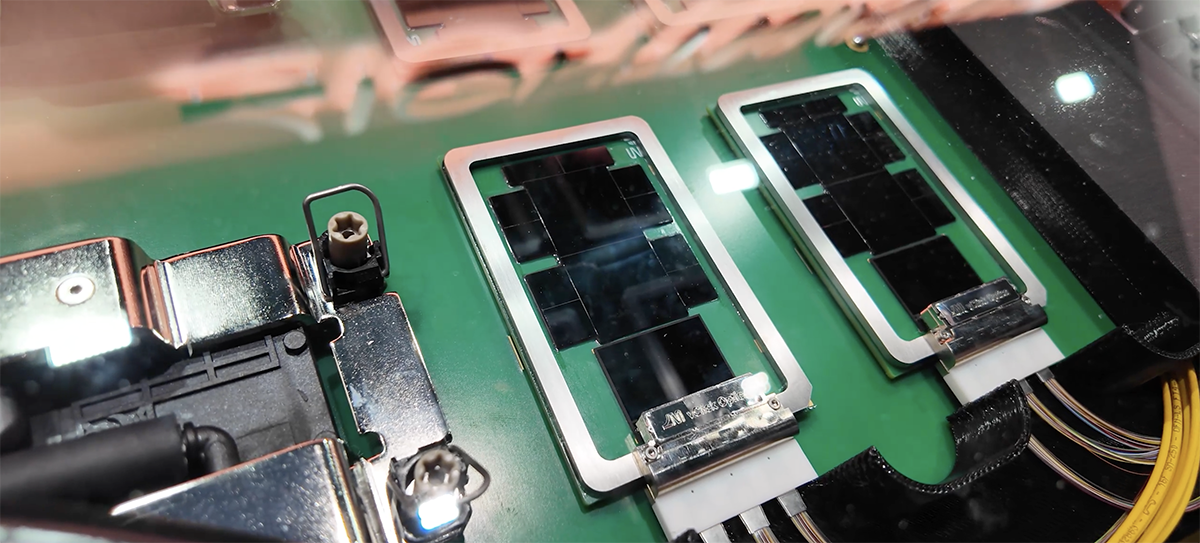
Lightmatter’s vClick Optics, developed with SENKO, addresses this requirement through SENKO’s SEAT detachable interface and Metallic Photonic Integrated Circuit Coupler (MPC) technologies combined with Lightmatter’s vertically expanded-beam photonics. Introduced earlier in 2026 and incorporated into the OCP systems, the approach supports identifying known-good dies and optical engines before final integration. Lightmatter reports compatibility with ASE’s mold-and-grind advanced packaging flows, no requirement for active fiber alignment during production, and demonstrated insertion and re-insertion loss below 1.5 dB.
This is a manufacturing proposition as much as a serviceability proposition. Detachability creates a boundary between processes that otherwise have to be managed as one permanent assembly. Its value depends on returning to a predictable optical connection: repeated attachment must preserve enough optical power for the complete link, including the other connections and routing losses along the path.
{INSERT Detail LM Switch OCP}
Density further along that path presents a related challenge. SENKO’s SN-MT platform addresses compact multifiber interconnection; its 16-fibre connector offers 2.7 times the density of MPO-16. Lightmatter highlighted SEAT and SN-MT as complementary requirements at the package interface and in high-density fiber connectivity.
These technologies address different parts of the system. A detachable package interface enables access to the photonic device, while a compact multifiber connector organizes connections farther along the optical path. Their value is realized together when package-level bandwidth can be carried through the tray without creating an unmanageable routing or maintenance burden.
Trend 5: External lasers and telemetry make optical operation visible
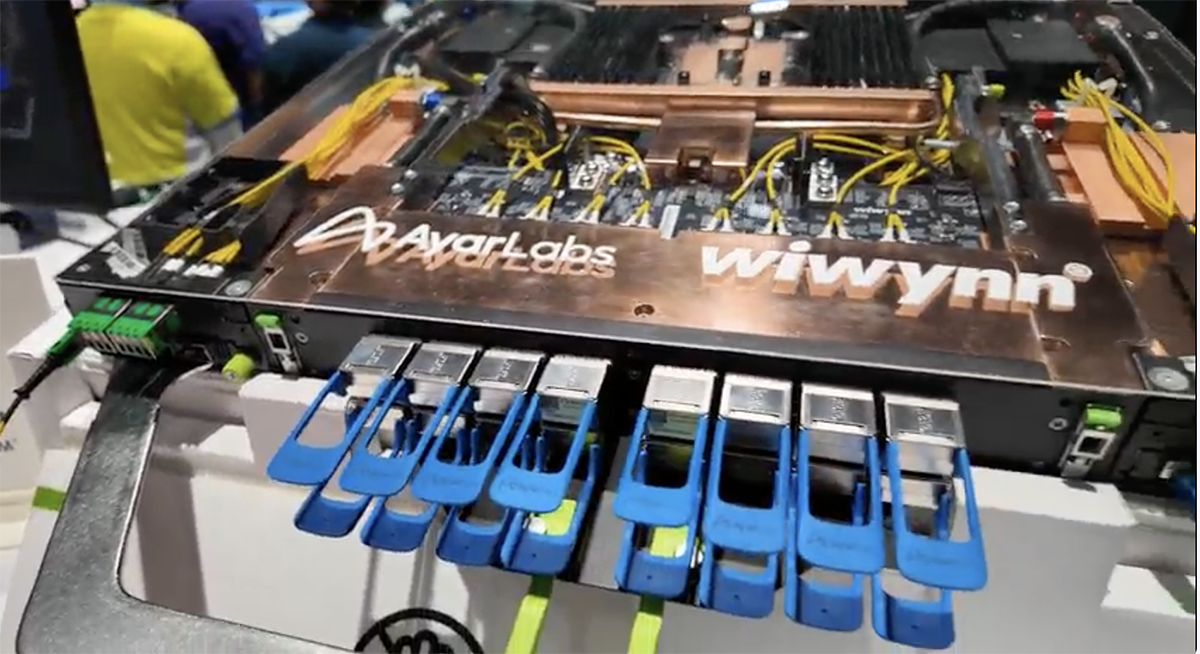
Wiwynn, Ayar Labs, and Global Unichip Corp. (GUC) brought an operational dimension to the discussion. Their live ORv3-ready compute system integrated GUC multi-chip packages with Ayar Labs’ TeraPHY optical engines and SuperNova external light sources in the external laser small form-factor pluggable (ELSFP) format. Detachable fiber-array units (FAUs) and in-chassis routing formed part of the demonstration.
The system continuously displayed optical-engine health information. Wiwynn reported that eye height, optical modulation amplitude and extinction ratio remained stable while the tuning subsystem tracked thermal and wavelength drift. Optical-engine and ELSFP temperatures were monitored alongside those signal-quality indicators.
These measurements matter because a functioning optical link is an actively managed system. Optical modulation amplitude describes the separation between the signal’s high and low optical power levels while extinction ratio expresses their ratio. Tracking them with temperature and tuning activity helps engineers assess whether the link maintains signal quality as operating conditions change. The demonstration brought that relationship into view within a compute chassis.
Externalizing the light source also creates a separate service boundary. It allows laser provision to be considered independently of the compute package, although the benefits depend on access, connector design and the system’s maintenance procedures. SENKO’s detachable FAU and ELSFP connectivity contributions to the Wiwynn/Ayar Labs activity address two points along this path: fiber attachment at the optical engine and connection to the external light source.
The broader lesson is that serviceability must include both physical access and diagnostic visibility. A detachable connection helps engineers reach a component while telemetry helps establish what needs attention. The live demonstration provides evidence of functional integration, while longer-duration qualification remains necessary to establish performance across deployment conditions.
Trend 6: Common interfaces are becoming part of the deployment strategy
The proliferation of optical approaches makes interface definition increasingly important. A system builder needs to know whether a connector footprint, optical budget and signaling arrangement will be supported beyond a single demonstration. Those requirements influence component qualification, sourcing and the ability to evolve a platform over successive generation.
At OCP, Credo launched the Short-Reach Micro-Emitter Optics (SRMO) workstream with SENKO among its initial participants. The proposed specification covers link power, efficiency, signaling, parallelism, module and connector footprints, link budgets and compliance, with OCP approval targeted for 2027. This is specification development, with interoperability still an objective to be established through agreed requirements and validation.
SENKO’s involvement brings the physical connector into that discussion while the architecture is taking shape. In a highly parallel link, agreement on signaling alone is insufficient. The optical channels must also meet at a consistent physical interface, with enough margin for the losses and tolerances of the assembled system. A common connector interface can make it easier for suppliers to build towards the same requirements.
The open rack and modular hardware work illustrated by Lightmatter addresses another level of the same challenge: where the optical systems fit and how they integrate with established server infrastructure. Together, these efforts show collaboration taking the form of engineering requirements that manufacturers and operators can use. Ecosystem strength is expressed through compatible interfaces, repeatable processes and a credible route to qualification.
Outlook: The backplane connects optical innovation to usable AI infrastructure
The strongest thread running through OCP 2026 was the connection between optical performance and the practical design of the AI rack. Credo’s parallel-channel backplane approach, TE’s integrated copper and optical systems, Lightmatter’s rack hardware and Wiwynn’s live telemetry each addressed a different condition for making bandwidth useful.
Backplanes sit at the center because they bring these decisions together. The package determines where light enters the fiber; the harness carries it through the tray; the blind-mate interface connects that tray to the wider system. At each stage, density and optical performance must coexist with assembly, cooling and service access.
SENKO’s work across these interfaces reflects the expanding role of optical connectivity engineering. Through backplane development, detachable fiber attachment, compact multifiber connectors and common interface specifications, SENKO is helping partners translate photonic capability into hardware that can be manufactured and maintained. As AI architectures become more deeply integrated, that ability to connect the complete system will help determine how effectively their bandwidth reaches the workloads it is designed to serve.

Data Center